
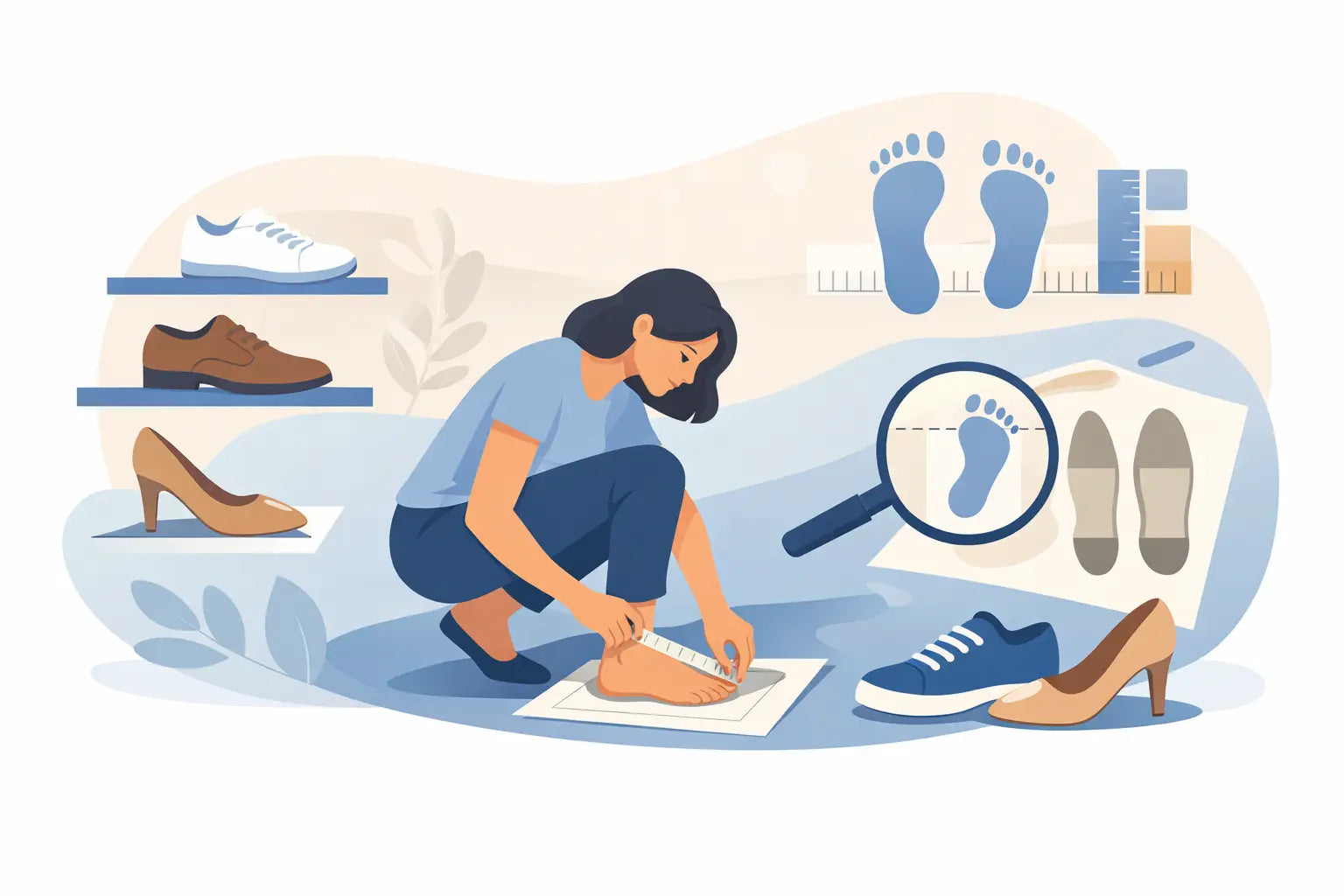
A shoe that looks right but fits wrong gets expensive fast. Blisters, heel slip, cramped toes, returns you did not plan for - it all starts with one simple miss. If you are wondering how to find your shoe size without guessing, the good news is you can get very close at home with a few minutes and the right method.
The goal is not just to land on a number. It is to get a fit that feels better on real days - commuting, working, walking, chasing kids, or standing longer than expected. Smart shopping starts with fewer assumptions.
How to find your shoe size at home
You do not need special equipment. A sheet of paper, a pen or pencil, a ruler or measuring tape, and the socks you would normally wear with that type of shoe are enough.
Start at the end of the day. Your feet naturally swell a bit as the day goes on, and that matters. Measuring in the morning can leave you with shoes that feel fine at 8 a.m. and too tight by dinner.
Place the paper on a hard floor, not carpet. Stand on it with your full weight evenly distributed. If you sit down while measuring, you can end up with a smaller number than your real standing size.
Trace around your foot or mark the longest points instead. For most people, the cleanest method is to mark the back of the heel and the tip of the longest toe, then measure that distance. Repeat for the width by measuring the widest part of your forefoot.
Measure both feet. This is the part many people skip, and it is where sizing problems start. One foot is often slightly longer or wider than the other. Use the larger foot as your baseline.
Write the measurement down in inches and centimeters if possible. Brand size charts can vary, and having the actual measurement gives you more flexibility when you compare sizing later.
The simplest measuring method
If you want the fastest version, stand on paper, mark heel and longest toe, measure the length, and compare that number to a brand chart. Add width if the style is structured, narrow, or not very forgiving.
That is enough for many casual shoes. But if you are buying boots, loafers, dress shoes, or kids' shoes, width and shape matter more than people think.
Length is only half the fit
A lot of shoppers focus only on size 8, 9, 10, and so on. But length alone does not tell the full story. Foot width, arch height, toe shape, and even instep volume can change whether a shoe feels great or impossible.
If the shoe is the right length but feels tight over the top of your foot, your instep may be higher than the shoe allows. If your toes feel squeezed even with enough front space, the toe box may be too narrow. If your heel lifts while the rest feels snug, the shape may not match your foot rather than the size being wrong.
This is why two shoes in the same labeled size can fit completely differently. Minimalist sneakers, pointed flats, chunky boots, and soft slides all play by different rules.
How much room should you have?
In most closed-toe shoes, you want about a thumb's width of space between your longest toe and the end of the shoe. Not more than that, or your foot may slide. Not less, or your toes will pay for it.
Your heel should feel secure without rubbing, and the widest part of your foot should sit naturally at the widest part of the shoe. If that alignment is off, sizing up is not always the answer. Sometimes you need a different shape, not a bigger number.
Shoe sizes are not universal
This is the part online shoppers learn quickly. A size 9 in one brand may fit like an 8.5 in another, especially when you compare sneakers, fashion shoes, and boots.
US men's, US women's, UK, and EU sizing do not convert perfectly across every brand either. Charts help, but they are still approximations. The most reliable starting point is your foot measurement, then the chart for the specific product or brand.
If you are between sizes, the right move depends on the shoe. For running shoes or anything you will wear with thicker socks, going up half a size often works better. For sandals or backless styles, too much extra length can make the fit sloppy. For leather shoes, a slightly snug fit may relax with wear, but only to a point. Pain is not a break-in strategy.
How to find your shoe size for different types of shoes
Not every category should fit the same way. That is where a lot of returns happen.
Sneakers usually need a little breathing room, especially if you walk a lot or wear athletic socks. A close but not tight fit is ideal. Your toes should move freely, and the shoe should feel stable through the middle of the foot.
Boots depend on shaft height, material, and intended use. Ankle boots can feel great with a bit of structure, while taller boots need to account for socks and calf fit too. If the toe box is narrow, sizing up may help, but a wide-fit option is often cleaner.
Dress shoes and loafers tend to be less forgiving. If they are stiff and sharply shaped, width becomes a bigger deal. A sleek silhouette is great, but not if your toes are compressed from the first wear.
Sandals are different. You want your foot to sit fully on the footbed without the heel hanging off the back or toes pushing over the front edge. Extra length is not helpful here. It just makes the shoe feel less secure.
Kids' shoes need the most frequent checks. Growth happens fast, and children do not always say when a shoe feels too small. Leave enough room for growth, but not so much that the foot slides around. Stability matters.
Common mistakes that throw off your size
The biggest one is measuring only one foot. The second is measuring while seated. After that, it is usually the wrong socks, the wrong time of day, or relying on your usual size without checking the style.
Another common mistake is confusing tightness with support. A supportive shoe should feel secure, not restrictive. If circulation, toe movement, or natural walking feels off, that is not a premium fit. That is friction waiting to happen.
People also tend to keep buying the same size they wore years ago. Feet can change with age, pregnancy, weight shifts, activity level, and time spent on hard surfaces. Rechecking once in a while is simply smart.
What to do if you are between sizes
This is where context matters. If your measurement lands between two sizes, think about material, shape, and use.
Soft knits and flexible uppers can be more forgiving in the smaller size if the fit is close. Structured leather or pointed styles usually reward a little more room. If you wear orthotics or thicker insoles, size up. If the shoe is open-back or strappy, too much extra length can create instability.
Width can be the deciding factor too. If the larger size gives you length but your heel slips, a wide option in the smaller size may solve the problem better than sizing up.
A better online shopping habit
The easiest way to shop smarter is to stop thinking of your shoe size as one fixed number. Think of it as a range shaped by category and construction. You may be one size in sneakers, half a size up in boots, and a different fit in narrow dress styles. That is normal.
Keep your foot measurements saved on your phone. Length for both feet, width, and a note on whether you have a high instep, wider forefoot, or narrower heel. That tiny habit cuts down guesswork every time you shop.
At Zavira, the best buys are the ones that make everyday life feel easier, not the ones that create extra hassle after checkout. A better fit does exactly that.
Once you know your real measurements, buying shoes gets simpler, faster, and more accurate. Less trial and error. More wear, less return label. That is the kind of upgrade worth making.
Share:
12 Best Kitchen Gadgets for Families
Best Curated Lifestyle Stores That Save Time